From Research to Application: Projects at Fraunhofer EMFT

Cancel
  • Chip Foil Package
    © Fraunhofer EMFT

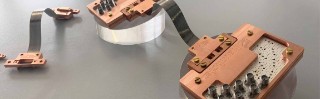
    Example of a chip foil package. The CFP project is developing new processes for the manufacture of ultra-thin, flexible chip packages.

    In the CFP project, Fraunhofer EMFT, Fraunhofer IZM, and Yamagata University are developing novel chip foil packages for flexible electronics. Together, they are working on materials, interconnection technologies, and an end-to-end process chain to reliably integrate electronic functions into soft, curved, or flexible surfaces. The goal is to create chip foil packages less than 150 micrometers thick that can be manufactured efficiently and sustainably in high volumes and used in medicine, industry, mobility, and other fields of application.

    more info

  • © Fraunhofer EMFT

    Shielded flexible superconducting interconnections with more than 80 signal lines per inch

    With the foundation of Munich Quantum Valley (MQV) in 2022, seven leading research institutions in Bavaria, including the Fraunhofer Gesellschaft, have committed themselves to an ambitious goal: Building the first German quantum computer with up to 1000 qubits “made in Bavaria”. The partners are working on realizing full-stack quantum-computer demonstrators, remotely accessible to researchers and industry. Within this framework, Fraunhofer EMFT researchers are contributing their engineering expertise to enable scaling and industrialization of the qubit platform based on superconducting qubits.

    more info
  • © Fraunhofer EMFT/ Bernd Müller

    Silicon wafer with aluminium qubit chips – close-up

    28 European research partners aim at designing, building and operating a quantum processor of up to 1000 qubits in Europe. As part of the project, Fraunhofer EMFT is providing the development of new fabrication processes for qubit chips, which will facilitate chip manufacturing on an industrial scale for commercial use in the future.

    more info
  • Quantum Chips Enter Industrial Manufacturing

    How the SUPREME Pilot Line Is Bridging Research and Scalable Production Made in Europe

    Multi Project superconducting wafer
    © Fraunhofer EMFT / M. Andronic

    Multi-project superconducting qubit structures wafer

    In the EU research project SUPREME, 23 partners from 8 member states are pooling their expertise to advance the development of stable manufacturing processes for superconducting quantum chips. The R&D activities specifically address the challenges related to the stability and yield of qubits – crucial factors for the scaling of quantum technologies and thus for Europe’s competitiveness in the global quantum hardware market.

    more info
  • The research project »Velektronik - Vertrauenswürdige Elektronik (ZEUS)« of the German Federal Ministry for Education and Research (BMBF), aims to establish a networking platform for trusted electronics as an interface between research and industry.

    more info
  • 2-pin test system in the Fraunhofer EMFT test lab for test and analysis of electronic components and systems

    2-pin test system in the Fraunhofer EMFT test lab for test and analysis of electronic components and systems

    The semiconductor industry and manufacturers of electronic components and systems test their products carefully to ensure that they function flawlessly. An important aspect is the tolerance of chips to ESD (electrostatic discharge). Fraunhofer EMFT and High Power Pulse Instruments GmbH (HPPI) have jointly developed a 2-pin test system that offers many advantages to the semiconductor industry.

    more info
  • Control of soldered connection
    © Fraunhofer EMFT/ Bernd Müller

    Control of soldered connection

    Microrelative movements can lead to crack formation and crack growth in press-fit connections. Together with the Institute of Materials Engineering and the Institute of Drive and Vehicle Technology, both at the University of Kassel, Fraunhofer EMFT researchers are working on a suitable accelerating model to better understand how these undesirable effects occur.

    more info
  • © Fraunhofer EMFT/ Bernd Müller

    Analysis and simulation of the damage behavior of press-fit joints due to mechanical and thermal loads.

    Press-fit technology provides an innovative connection method which, due to its high reliability and robustness, is particularly suitable for safety-relevant connection points. Another advantage is that the method is much more eco-friendly than the soldering technique most commonly used to date. A Fraunhofer EMFT research team is working on a predictive model that relates easily accessible material/process data to the reliability of press-fit contacts.

    more info
  • Electrical Interconnection Technology as Diagnostic Interface
    © Fraunhofer EMFT/ Bernd Müller

    Wireless intelligent PCB connector for continuous measurement of contact temperature and individual contact current load, providing key data for predictive maintenance

    Whether in automobiles – especially in the context of autonomous driving – or future industrial manufacturing: plugs and electrical connection technologies have a key role to play in digital networking. They are the main interface between machines, control units and data processing systems and so they provide the basis for the functionality, simple handling and reliability of automation technology.

    more info
  • Autosplice

    Autosplice

    In the PCB direct contacting research project (T-1753), Fraunhofer EMFT investigated PCB direct contacting systems for highly reliable mechatronic and drive technology applications. The aim was to evaluate commercially available systems in terms of technical performance, reliability and economic suitability under realistic environmental and stress conditions.

    more info